Logo
Follow Us on FacebookFollow Us on InstagramFollow Us on YouTubeFollow Us on LinkedIn
Phone: 757-466-7555
  • HOME
  • ABOUT US
    • Our Access, Belonging, Inclusion, Diversity, and Equity (ABIDE) Statement
    • Our Board of Directors
      • Our Board of Directors 2025-2026
      • Our Board of Directors 2024-2025
      • Our Board of Directors 2023-2024
    • Our Employment Opportunities
    • Our Financials (990 and Audit)
      • 990 Form 2023-2024
      • Audit 2023-2024
    • Our Impact Report
      • Our Impact Report 2024-2025
      • Our Impact Report 2023-2024
      • Our Impact Report 2022-2023
    • Our National Network
    • Our Staff
      • Contact Us
    • Our Strategic Plan
  • PROGRAMS
    • Calendar of Events
    • Schedule a Program
    • Find A Program
    • Arts + Learning Snacks
    • Coastal Virginia Wolf Trap
  • SUPPORT
    • Our Supporters
      • Our Community of Supporters 2024 – 2025
      • Our Supporters 2023 – 2024
      • Our Supporters 2022 – 2023
      • Our Supporters 2021 – 2022
    • Individual Giving
    • Give Back Through Rewards
  • GET INVOLVED
    • Become an A4L Artist
    • Become a Board Member
    • Internships
    • Program Observer
    • Volunteer
  • Our Stories
    • Our History
  • Virtual Arts

My Teaching Artist Journey with Arts for Learning Virginia

July 29, 2025 By Jackie Adonis

My name is Jackie Adonis, and I’ve been a Teaching Artist with Arts for Learning Virginia for the past three years, sharing my passion for Filipino dance and theater throughout Virginia. Whether my time with my students is brief, such as for a workshop, or longer, such as for a residency, I see the impact we have on future generations in real time, and that’s both meaningful and humbling.

It all started with an audition I wasn’t even supposed to do. For two years, I’d worked as a House Manager for the Zeiders American Dream Theater. During the first year of the Z’s Common Casting Call, performing artists auditioned for various arts organizations in the area, including the Virginia Stage Company, Virginia Musical Theatre, Virginia Beach Cultural Affairs, and Arts for Learning Virginia. As House Manager, I welcomed each auditionee as they arrived.

The day began swiftly and smoothly…and then, there was a lull. I tried to mask my ADHD and sit still. Then, I noticed members of the different organizations walking around, also restless as they waited for the next wave of auditionees. Finally, as I was about to burst, I asked the Z’s Executive Director, Terry Flint, if I could audition while we were waiting. Conveniently, I had my headshot, resume, and sheet music in my bag and a monologue in my metaphorical back pocket. Terry said yes.

It wasn’t the ideal audition situation. I was dehydrated, I hadn’t warmed up my voice, and I hadn’t brought a change of clothes, so I was wearing my House Manager uniform and a sweaty ponytail. All I had to show the most prestigious performing arts organizations in Hampton Roads was myself.

At that point in my life, I was unsure of what I was doing. The global pandemic deferred my dreams of going to New York City after graduating from acting school. The way that COVID-19 pulled the rug from underneath all of us had me questioning what my purpose in life was—or if there was a purpose at all. I had no idea that day at the Z would change my life.

I sang “Days” from Fun Home. I performed a monologue from Goodbye, Charles. I did some cold reads and improv. Then, I thanked everyone for giving me a break from work and returned to my welcome table at the front entrance.

The end of my shift involved tidying up the restrooms—glamorous, I know. I wiped the sweat off my forehead, and when I got out of the final bathroom, Arts for Learning’s Programs and Community Engagement Manager, Aisha Noel, was waiting for me with her business card. “I want to build a program with you,” she said. “We need more artists like you.” I knew nothing about teaching or building a program. I didn’t even know this person. However, I did know how I felt, and I felt seen.

I called Aisha later, on a weekday. She set me up with Drew Lusher, A4L-VA’s former Artist and Programming Manager, who helped me build my first Arts for Learning program, which centered on a dance I’d done since I was a child: the Itik Itik (loosely translated, the Dance of the Duck).
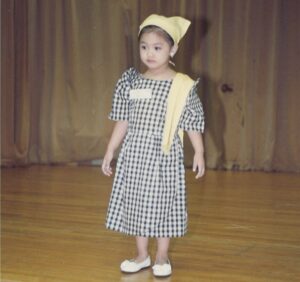
Jackie performing the Itik Itik.

I learned the Itik Itik at age two when I lived in Roanoke. My parents and their friends were part of the Philippine-American Association there. This group put together programs to showcase the songs and dances of our culture, and members and their families were invited to perform in these showcases. Even though I was “voluntold” to be on stage, I was delighted to do so because I already felt I belonged there.
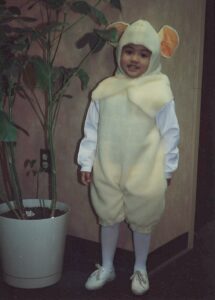
Jackie as a sheep.

I had no idea that decades later I’d be asked to share this dance with hundreds of kids all over Virginia. After speaking with Aisha and Drew, I cried happy tears at the prospect of sharing my culture, something that was difficult growing up in Roanoke. My classmates made fun of me for bringing food from home, saying it smelled bad. In kindergarten, I was put in timeout for not speaking English in class. I could speak English well—it was just that no one told me that I had to speak English outside the home. I was only five years old. How was I supposed to know? I thought everyone could speak Tagalog, so when I asked for tubig (water), my teacher called my mom and said I was saying “bad words in class.” My mom definitely shared some words with her.

After that incident, my parents only spoke to me in English to prevent me from getting confused. Over time, I forgot how to speak my language. I felt only the remnants of rolled r’s on the tip of my tongue. I stopped bringing food to school and started eating the terrible cafeteria food. I learned how to be less of my culture, less of myself.
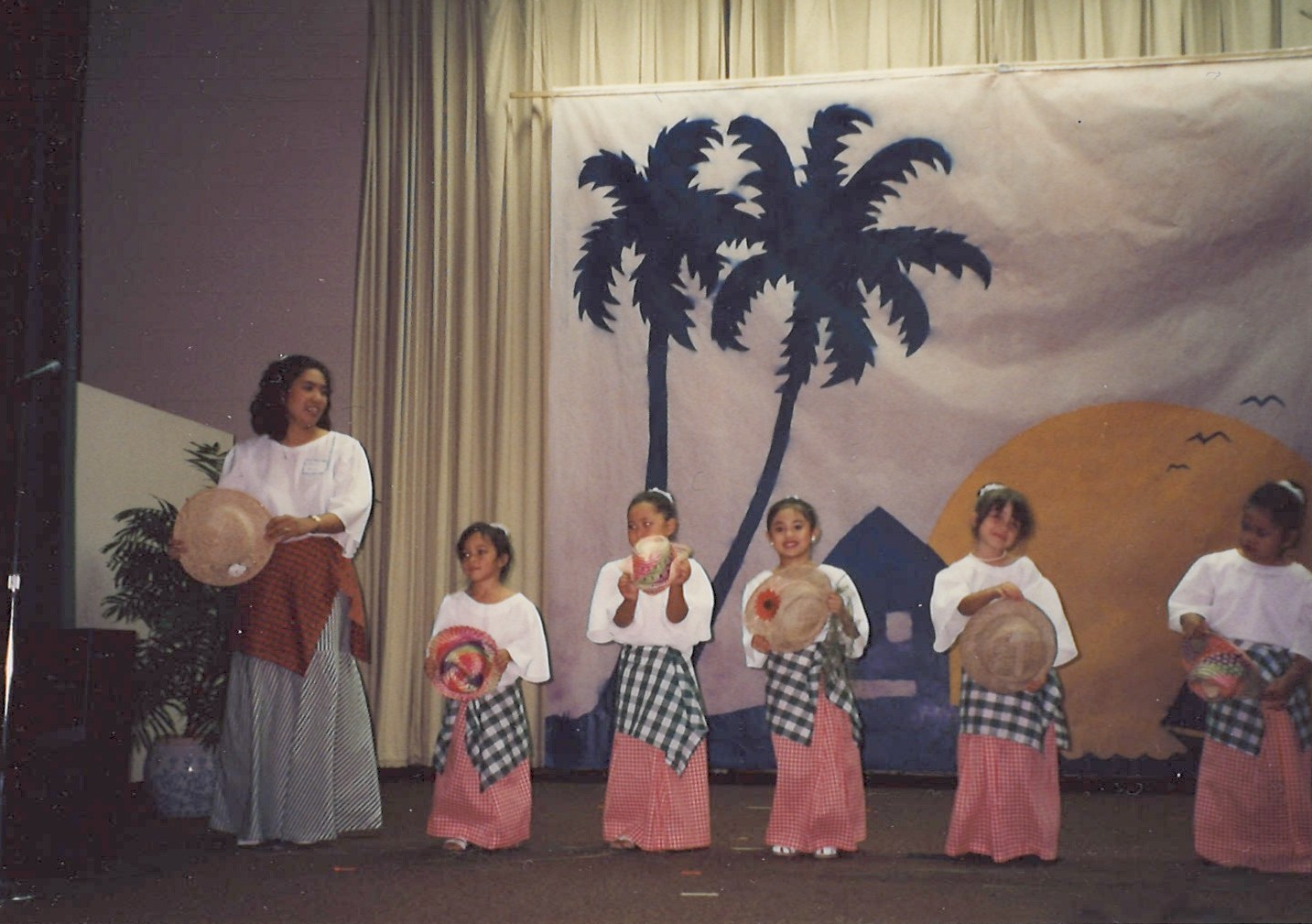
  • "Planting rice" program.
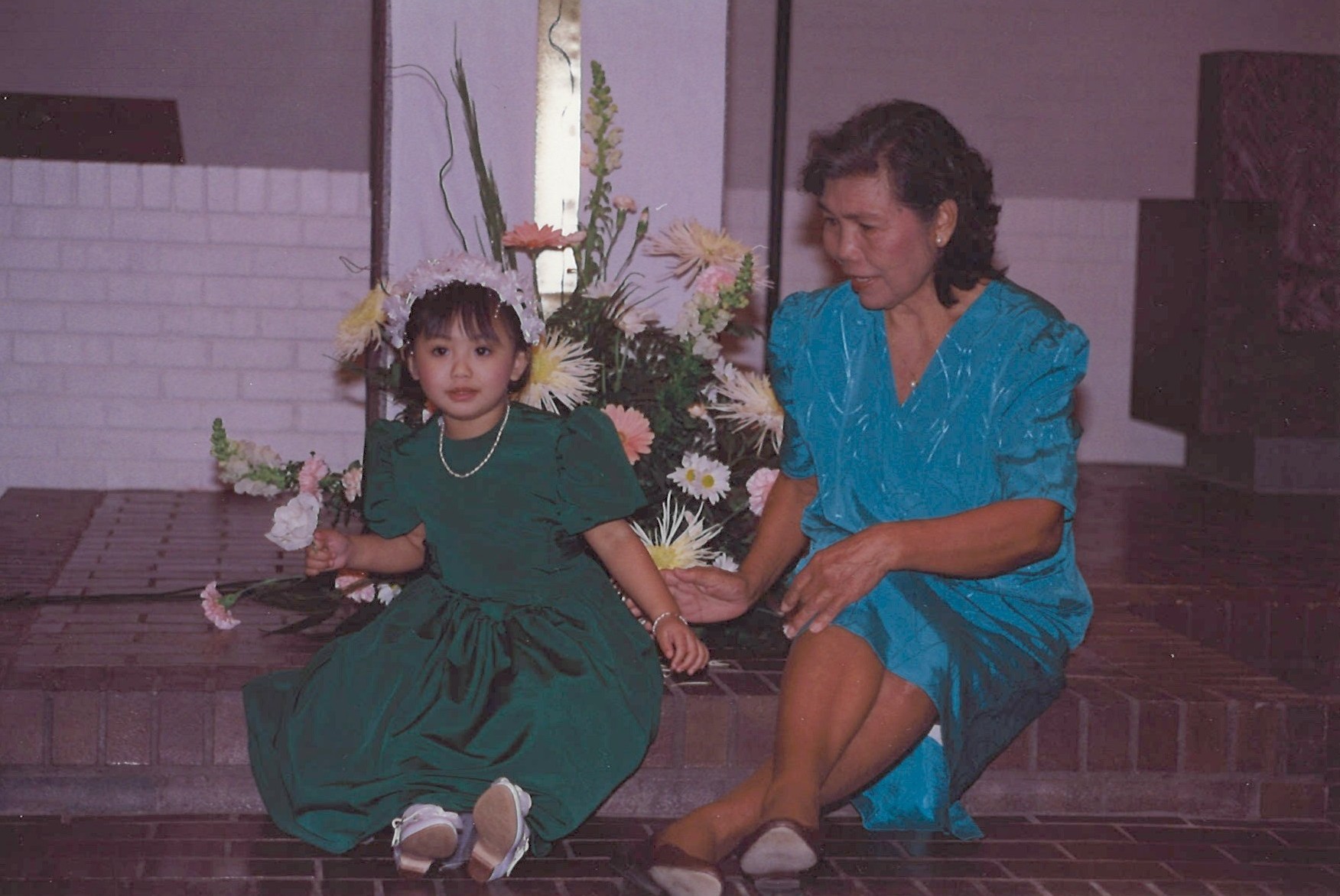
  • Jackie and "Lola," the Filipino word for grandmother, in 1993. Lola taught Jackie to play the piano and sing when she was two.
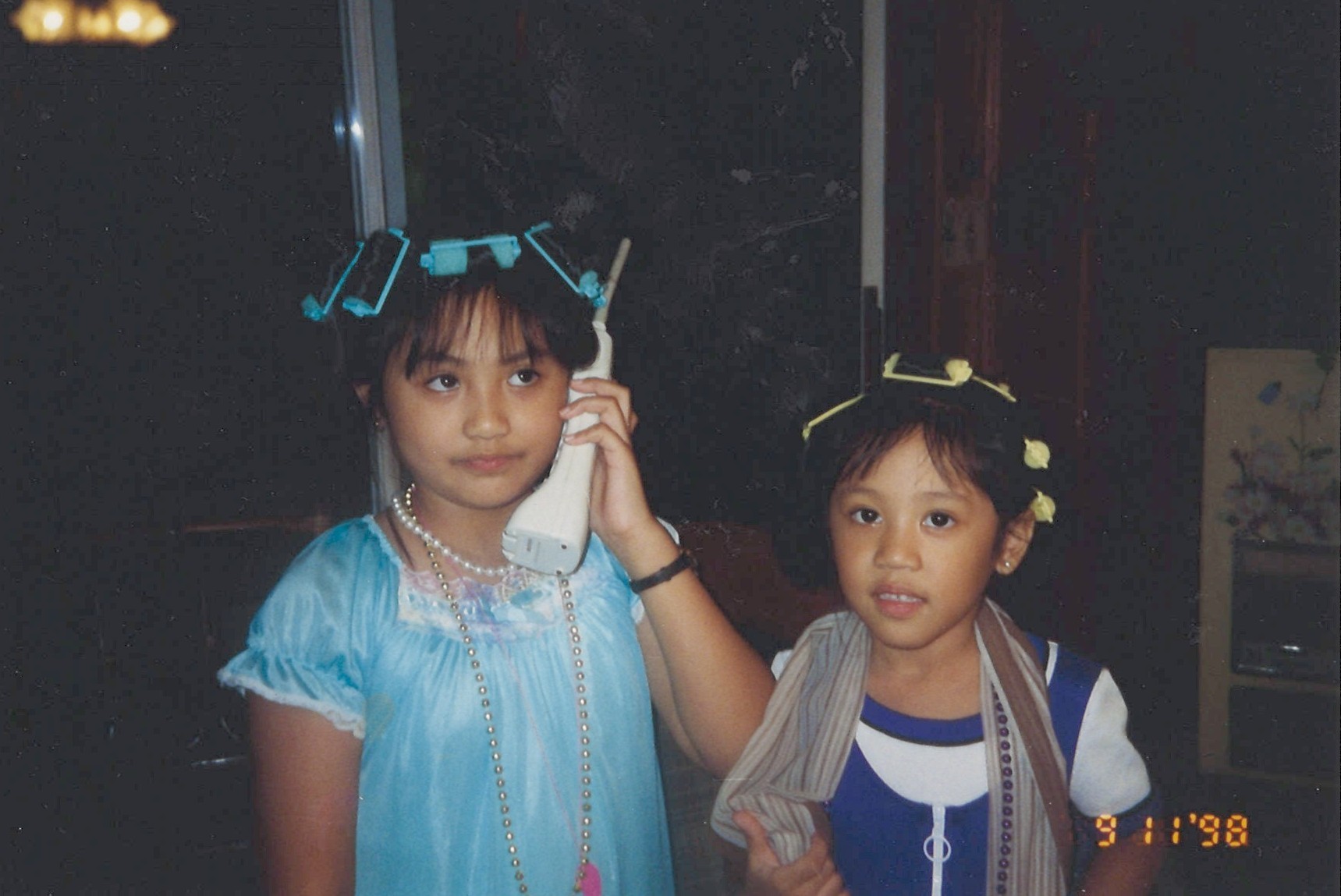
  • Jackie and her cousin, 1998.
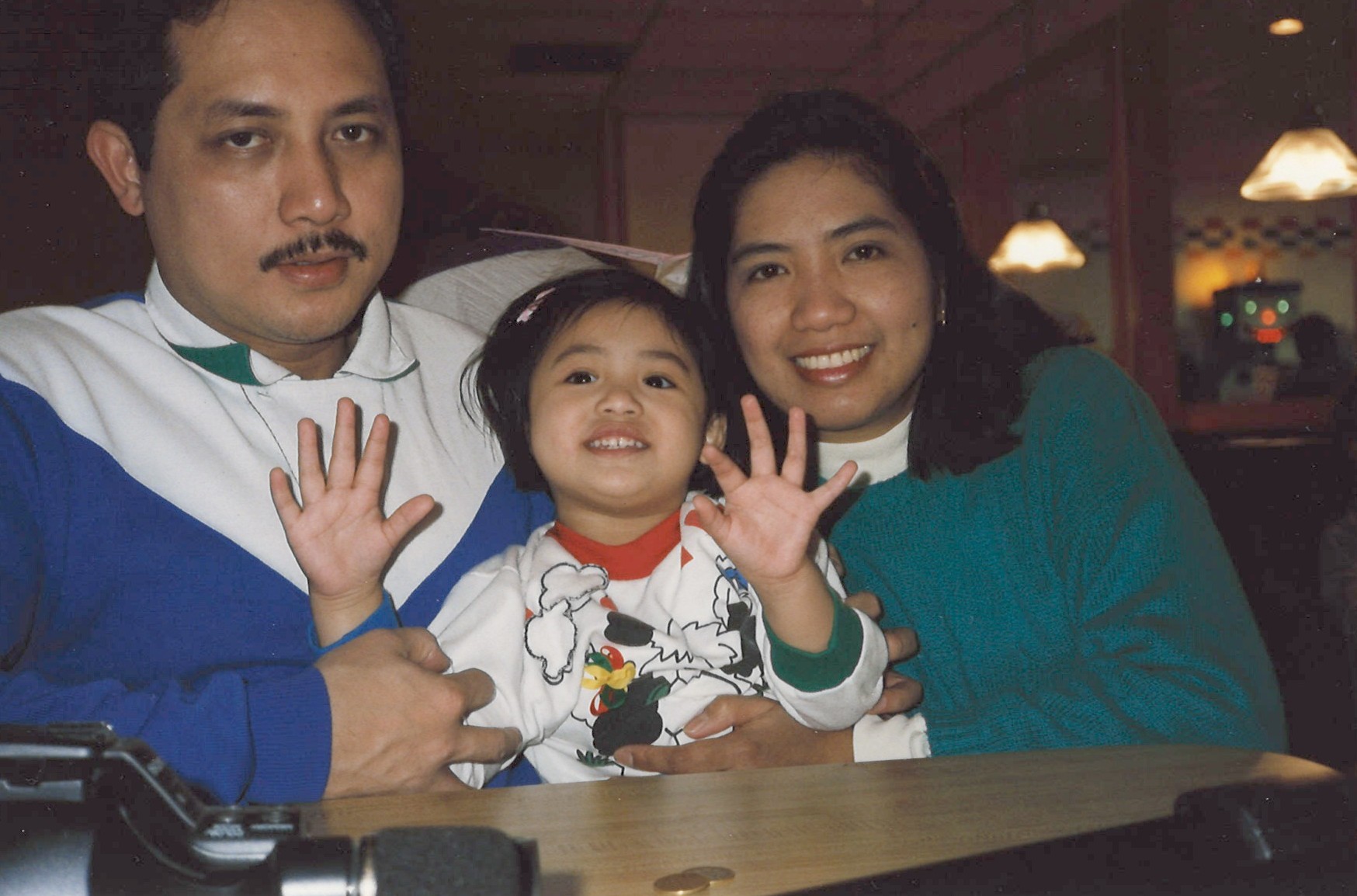
  • Jackie with her parents at a Chuck E. Cheese birthday, 1993

Fast forward decades later, and Arts for Learning was asking me to share my culture. I was reassured that being myself—fully myself—was welcome. This reignited a flame within me, and with each workshop I did, that flame spread. Whenever children told me they were Filipino too, I was happy that they felt seen and represented in a way I wasn’t when I was their age. It was also heartwarming to see my non-Filipino students embrace a culture that was different from their own. It meant so much to see them bright-eyed with curiosity to learn more.

I was already content to serve our communities in this way, but then Arts for Learning gave me another opportunity: the IDEAL program. IDEAL stands for Intentional Designs of Expression in Artistic Languages. Our goal was to help fourth to sixth grade students prepare for middle school by using various art forms to explore questions such as, “Who am I?” and “How am I a part of my community?” This residency lasted for three years, with each year concluding at the Chrysler Museum of Art, where students’ art pieces were professionally exhibited.
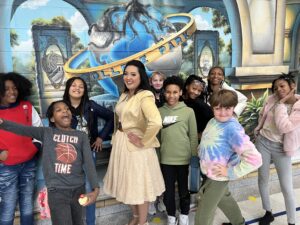
Jackie with IDEAL students at College Park Elementary.

I served for three years at three different schools. Each year, the students developed a different “theme” that defined their class. During my first year at College Park Elementary School in Virginia Beach, the arts were an anchor amidst my students’ chaotic home lives. The arts became a stabilizing force for them, a way for them to express their feelings in a healthy way.
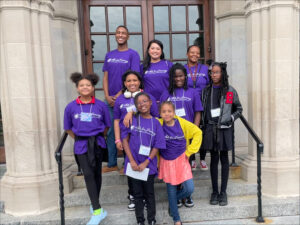
Jackie and fellow teaching artist Dai Poole with IDEAL students from Southside STEM Academy at Campostella.

The following year at Norfolk’s Southside STEM Academy at Campostella, the arts became a tool for students’ personal growth. It challenged them to go outside their comfort zones and discover they were capable of more than they thought.
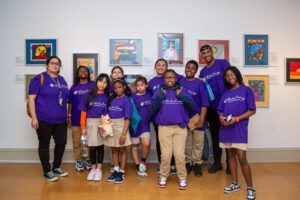
Jackie and Dai with IDEAL students from Lake Taylor School.

During this past spring at Norfolk’s Lake Taylor School, the arts served as a tool for building community. Each student had a distinct personality, and the act of exploring creativity was the thread that knitted this class closer together.
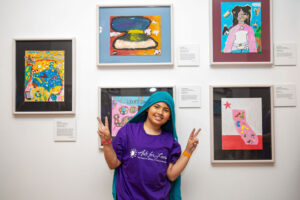
During all three years, I witnessed my students seeing their art displayed in the Chrysler Museum—and those moments were truly life-changing. This year, I said to a student’s mom, “I can only imagine how you must feel knowing that your son is an exhibited artist.” Overcome with joy, she embraced me.
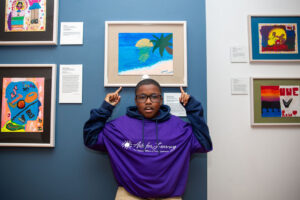
Every student walked out of the Chrysler Museum a changed person, as they realized, “If I just did that, I can do anything.” I felt myself change as well. Each year, I asked myself, “Did that really just happen? Did I really get to witness all these transformations?” The parents of my students told me, “You didn’t just witness it; you were a part of it.” I’m floored every time I hear that. I credit my students who worked so hard, and I thank them for allowing me to be part of their journeys.

As if Arts for Learning didn’t provide me with enough opportunities, they also invited me to participate in the RAISE residency. RAISE stands for Responsive Arts in School Education. For two years, I trained with other Young Audiences’ Teaching Artists over Zoom to learn how to integrate the arts into school curriculum, as well as how to enter classrooms with a trauma-informed, healing-centered approach. This involves supporting students as they discover who they are, honoring their agency and fostering a sense of community and belonging. During the winter and spring, I served as the Resident Teaching Artist on Tuesdays and Thursdays in Ms. Nancy Eason’s second-grade class at Armstrong School for the Arts in Hampton.
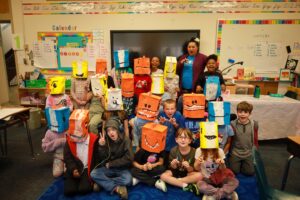
Ms. Eason and I collaborated on curriculum focused on literacy, using the art form of theater to engage students. Lessons featured story sequencing and story recall, with students to create a show based on a book they selected. The class voted for We Don’t Eat Our Classmates by Ryan T. Higgins, a story about a T-Rex named Penelope who learns the dos and don’ts of making friends at school. I then adapted the book into a short play. Over the course of the residency, Ms. Eason noticed that her students who had difficulties with reading at the beginning of the school year gained newfound confidence from their improved skills. In fact, one of these students auditioned for Penelope the T-Rex and got the role!
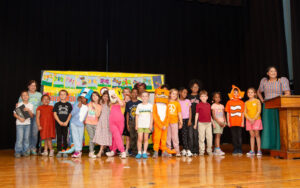
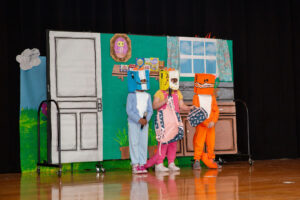
Ms. Eason told me she was amazed that some of her shyer students came out of their shells to perform willingly and with enthusiasm. For the students who didn’t feel comfortable on stage, we ensured they still felt part of the community as members of the stage crew, moving set pieces whenever the scenery needed to change. Another student created music for the slow-motion sequence in the play. All students had a huge hand in designing and decorating the set pieces. (The only exception—for obvious reasons—was Ms. Eason using a jigsaw to carve a giant “fishbowl” out of foam.) The rest of the show was entirely their work, including the costumes. One student hand-sewed the dinosaur tails herself.

It was wonderful to see that everything I had learned via Zoom years prior was coming to fruition, as students discovered new aspects of themselves while putting together a show. We honored each kid’s agency—they chose which story we’d turn into a play, they chose which parts to audition for, they chose whether to audition at all, and they chose how to contribute if they didn’t audition. Ultimately, it was remarkable how each student’s individual skills created a sense of community in the class. Everyone was doing their part to contribute to something bigger than themselves: our cast, our crew, our creative team—our show. Due to the kids’ hard work, the show was a huge success!
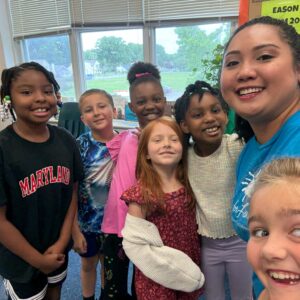
In a full-circle moment for a residency focused on literacy, Ms. Eason’s class invited me back in June for their Author’s Tea. Each student put their own spin on a classic fairytale, such as the Three Little Pigs or Goldilocks, and then created their own books. Once again, students made their books by hand—the storyline, the illustrations, everything. The only thing Ms. Eason did was bind the books. It was the end of the school year, and I could see that students had gone above and beyond in developing their skills of story recall and story sequencing. I felt so proud of them and so happy I could celebrate their accomplishments with them.
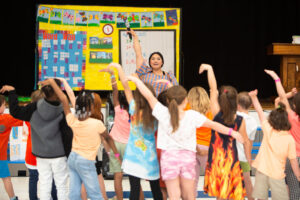
Whether we met once through a workshop or collaborated over a more extended period through a residency, I hope my students know how grateful I am to have shared that time with them. I hope they know how much they’ve changed me. I’m different from the person I was before Arts for Learning discovered me years ago. Back then, freshly post-pandemic, the present and future looked bleak. I felt trapped and stuck, questioning my purpose. Through my students’ eyes, I see hope and optimism. They’ve reminded me that amazing things can and do happen. They’ve shown me that my purpose is right here, with them.

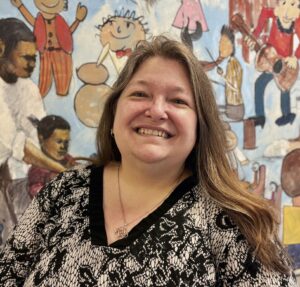
In addition to her work as a Teaching Artist, Jackie now works for A4L-VA as a Program Assistant. She is also one of our Coastal Virginia Wolf Trap teaching artists. We appreciate her contributions to our organization every day.
 

Filed Under: Artist Spotlight, Program Spotlight, Staff Spotlight, Wolf Trap Teaching Artists Tagged With: 757 arts, 757 nonprofit, Armstrong School for the Arts, Arts Ed, arts education, Arts for Learning, Arts for Learning Virginia, arts-in-education, Coastal Virginia Wolf Trap, dance, Hampton City Schools, Jackie Adonis, Norfolk Public Schools, RAISE, residency, teaching artist, Virginia Beach City Public Schools, Wolf Trap, Wolf Trap teaching artist

Arts for Learning Virginia Names New CEO to Lead Arts-in-Education Nonprofit

July 2, 2025 By Cindy Sherwood

The Board of Directors of Arts for Learning, the Virginia Affiliate of Young Audiences, voted at its annual meeting to name Anna Heywood Green as CEO of the organization.

Heywood Green has served as Interim CEO since January 1, following the retirement of former CEO Christine Everly. Prior to January, Heywood Green worked as the organization’s COO; however, she has experience in virtually all facets of the organization, having started at Young Audiences as Scheduling Director on January 4, 2004, more than 21 years ago.

“Anna Heywood Green has the knowledge, experience, and leadership skills to take us forward to greater achievement in supporting childhood education in and through the arts across the Commonwealth of Virginia,” said Dr. D. Michael Geller, President of the Board of Directors.

“Anna’s passion for the organization and its mission has been inspiring these past 21 years,” said Kate Roth, Treasurer of the Board of Directors. “We can’t wait to see how the organization flourishes under her care.”

During the 2025-2026 fiscal year that began July 1, Heywood Green’s top priorities include:

  • Deepening relationships with the organization’s school and community partners.
  • Expanding access to high-quality arts learning for students who need it most.
  • Strengthening the organization’s financial foundation to support artists and programs well into the future.

“I’m absolutely thrilled to lead Arts for Learning Virginia into this exciting new chapter,” Heywood Green said. “After more than 20 years with this organization, I know firsthand the incredible impact our professional artists have on students—sparking creativity, curiosity, and confidence across the Commonwealth. I’m eager to build on our strong foundation and work alongside our amazing partners to expand access to arts learning experiences that truly change lives.”

We talked with Anna last year as she celebrated her 20th anniversary with Arts for Learning Virginia. Why does she remain so committed to the organization after so many years? Read more here, and learn about her journey, her proudest moments, and her grandmother’s influence on programming dear to Anna’s heart.

Arts for Learning Virginia (A4L-VA) is the premier arts-in-education nonprofit organization in Virginia with a mission to inspire and engage students in and through the arts. A4L-VA and its roster of professional performing and teaching artists partner with schools, libraries, and community centers to serve tens of thousands of pre-K to 12th grade students each year, helping them realize their full potential through the arts.  

Filed Under: Board of Directors, News, Press Releases, Staff Spotlight Tagged With: 757 arts, 757 nonprofit, Anna Heywood Green, arts education, Arts for Learning, Arts for Learning Virginia, arts-in-education, board of directors, CEO

Celebrating 20 Years with Young Audiences/Arts for Learning: Talking with Anna Green, Chief Operations Officer

January 4, 2024 By Cindy Sherwood

On January 4, 2004, Anna started work as Scheduling Director for Young Audiences of Virginia, booking hundreds of artistic performances a year. On this day, twenty years later, we learn why she remains more committed than ever to the philosophy and practice of producing exceptional arts education for Virginia’s children.
“The first thing that comes to mind is believing in the mission. Because that drives you every day, it gets you out of bed. I decided long ago that nonprofit was my place. You’re creating and you’re living an authentic life because that’s the reflection of art is life. And vice versa, life is art.”

Where It All Began

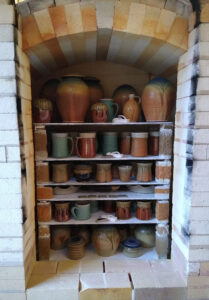
Anna’s parents are professional potters who opened their business when she was three years old. “When you’re raised in a family of artists, that’s pretty much your driving factor. I was always involved in the arts.”
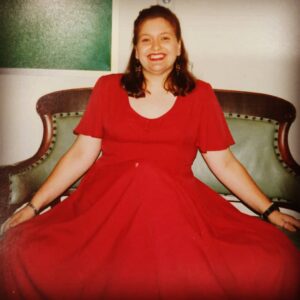
When she was 18, Anna was looking for a job after graduating from Maury High School where she’d been involved in the performing arts. “I walked from Ghent down to the Wells Theatre where my grandmother and I had been season ticket holders, and I walked into the box office and asked how I could apply to work there. I ended up interviewing that day with the box office manager, who hired me.

“And then I walked another day to the Generic Theater and Hurrah Players that were off of 21st Street at the time and asked if I could volunteer. So I was working at Virginia Stage Company at the Wells Theatre and volunteering for Bob Nelson at Generic Theater and that’s what started the process of my being in nonprofit arts.”

She briefly worked at a for-profit company, but quickly learned it wasn’t for her. “Working in an office every day for money and not creating art didn’t feel right.”

The Next Chapter

After nearly ten years learning different aspects of arts administration with Virginia Stage Company, Virginia Arts Festival, and smaller arts nonprofits, Anna was ready for a new challenge and accepted the job at Young Audiences.

“I spent the first part of my time at Young Audiences scheduling programs and reaching out to artists, introducing myself and establishing those relationships. It was nice to form such lifelong bonds with them, explaining to them that I had parents who were artists, and so I understood that this was their livelihood. And I think that they respected me more for knowing and understanding that, and then I worked really hard to get them bookings.”

It was a couple of years into the job that the education portion of YAV’s mission resonated more deeply with Anna.

“In the beginning it was the artists and then it was the children. And then I had my own child, and it was the children and the artists and the teaching and how all that came together—I can respect the artists that do the work and want them to be paid their professional fees, I can see the children and how much it means to them and what a difference it makes in their lives, and then I can respect the educational components and how we teach further understanding of knowledge in and through the arts.”

Becoming COO

By jumping in and learning about all different aspects of YAV, Anna became an invaluable resource to the organization. In August 2016, the board of directors named her to the new position of Chief Operations Officer, a management role in which she influences every facet of the nonprofit.

“There was an opportunity and a need for someone to step in who knew all aspects of the business. I had worked in finance. I had done development. I’d done bookings and marketing, I’d assisted the executive director, I’d written our volunteer handbook, I’d run residencies. When I became the COO, there was a real need for someone who understood and was familiar with the structure of the organization, who could keep things moving and running, so I stepped in and said I’m here to help.”

Her job keeps evolving. In August 2023, Anna assumed a new challenge as she took over the duties of a finance manager. It’s an area in which she’s always excelled, but it’s the first time she’s been responsible for the hands-on duties that the job entails. And that’s something she’s loved about her twenty years at Young Audiences/Arts for Learning: although some basics such as booking programming remain the same year after year, others change as the organization responds to changing needs with new services. That mixes it up for Anna who says she always has to “have things that keep me going in a job to keep it interesting.”

Staff members celebrate Arts for Learning’s 65th anniversary in September 2019.

Greatest Accomplishments

In looking back on her time at the nonprofit, Anna is proudest of two very different accomplishments. First, she was instrumental in conducting an IT assessment that convinced the board to invest funds in updating the technology that’s needed to run an efficient, modern-day nonprofit. In March 2020, when COVID-19 shut down schools and hundreds of Arts for Learning programs were canceled, that technology made all the difference—employees were able to work from home with laptops connected through the A4L server. Within two weeks, our artists were producing short videos designed for students learning at home.

“Without the technology, we wouldn’t have been able to do that, let alone our jobs at all. It meant that we were able to do programming for the kids. It didn’t stop the work, and our downtime was only two weeks, and I’m really, really proud.”
That digital programming, known as “Take 10,” won the 2020 Dominion ArtStars award for Eastern Virginia, recognized for its innovation, enterprise, and artistic quality.

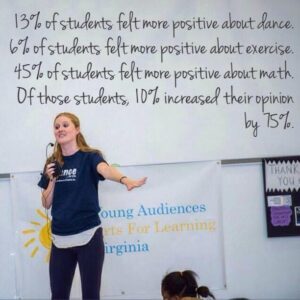
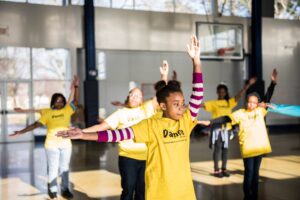
But Anna is just as proud of another program that won the ArtStars Award, and it’s one that remains close to her heart. In her senior year of high school, Anna lived with her namesake grandmother, Anna Henderson, in Norfolk. Her grandmother had been a teacher at Maury High School and headed Norfolk Public Schools’ math department for a number of years. And although she thought Young Audiences did good work, she had told Anna she thought there was a bigger role for using the arts to teach math. In 2014, the two Annas collaborated on the first iteration of the Dance for Life program, working together on curriculum, session by session, along with teaching artists Cindy Aitken and Sheena Jeffers.

Teaching artist Sheena Jeffers describes the positive effects of Dance for Life.
Dance for Life


“My grandmother was in her recliner. She didn’t walk well, she was having trouble. I’d visit her every Sunday and I’d bring the curriculum I was working on. I wrote that with her.”

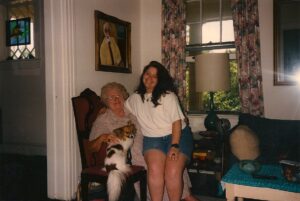
Anna with her beloved grandmother in earlier years.

The elder Anna fell in October of 2014 and broke her hip. She passed away in January of 2015. The next year Dance for Life would go on to win the Dominion Energy ArtStars Award presented by the Virginia Commission for the Arts.

And to have the Dance for Life program go on and be as successful as it was and for it to win the ArtStars Award was very fulfilling. It was such an honor to do that with her.”

Goals in 2024 and Beyond

Max and Anna
A4L board president Dr. Michael Geller and Anna at the December board of directors meeting.

Today, January 4th, is a day to honor Anna’s twenty years and all she has brought to our organization. The celebration began at December’s board of directors’ meeting when president Dr. Michael Geller surprised Anna with recognition from the entire board. The occasion was made even more special by her 13-year-old teenager, Max, being on hand to witness it.

As for the coming year, Anna is looking forward to furthering the cohesion of the staff, building the roster of artists, developing programs, and being “proud of what we’re putting out.”

And although she’s celebrating a major milestone, it’s fair to say that her dedication to Arts for Learning’s mission hasn’t dimmed.

“That’s what I wake up with every day—how am I helping the organization achieve what it’s meant to do? Because the arts is the telescope, it’s the magnifier, for learning to happen, and that’s what we’re here for. We’re providing something different and unique that students aren’t seeing in the regular classroom.”

On behalf of the staff and board of Arts for Learning, we wish Anna a very happy 20th “workiversary.” We’re grateful for all her contributions to the students we serve, and our artist, educator, and community partners.

Filed Under: News, Staff Spotlight Tagged With: 757 arts, 757 nonprofit, Anna Heywood Green, anniversary, Arts for Learning Virginia, Young Audiences of Virginia

The Arts, Education, and Society: An Interview with Drew Lusher, A4L’s New Artist and Programming Manager

November 2, 2022 By Cindy Sherwood

You have a music background, right? When did your engagement with music begin?

In high school, Drew played the lead in the school’s production of South Pacific.

I was fortunate to grow up in an environment surrounded by music. My mother had a vast record collection, my favorite of which was an album of Bach’s Brandenburg Concertos – I loved the blasting of the baroque horns through the stereo.

But in terms of making music, that really began in the fourth grade – the year I started playing trombone and singing in the school chorus and the year my grandparents first brought me to a concert by our local symphony orchestra (The Syracuse Symphony). I was immediately enamored with the soundscape of the live orchestra and the energy of the conductor. From then I was asking for CDs of Beethoven and Mahler (while my friends wanted CDs of Eminem and Britney Spears).

Of course, I was also fortunate to have amazing music educators who fostered my relationship with the arts.

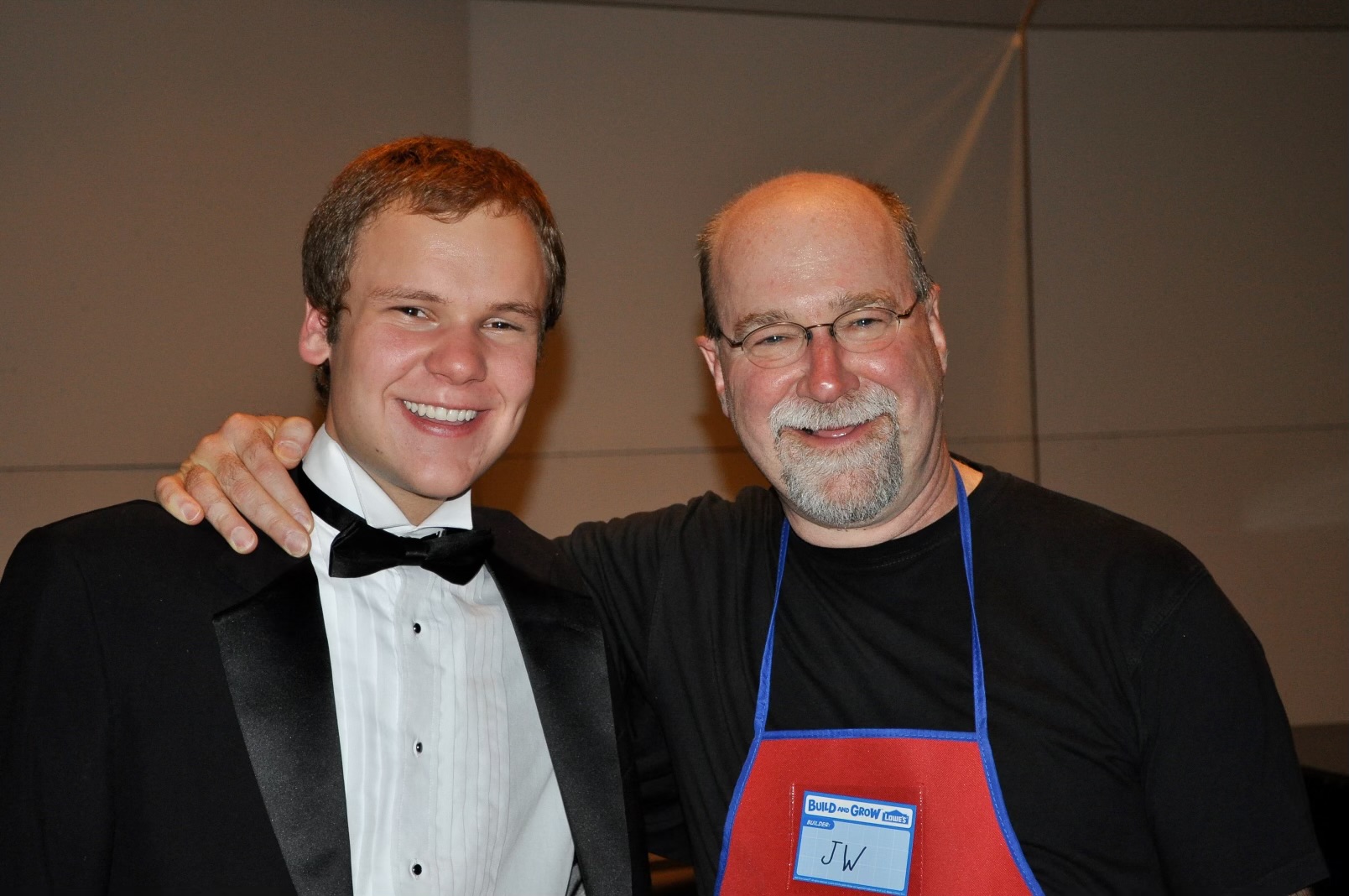
Drew with his high school chorus teacher, who remains an important mentor.

So there really wasn’t a singular experience that sparked my relationship with music, I was blessed with an environment that fostered those early experiences.

You grew up surrounded by opportunities to study and perform. How did that connect to your later experiences?

By the time I graduated high school, I understood that participation in the arts was a collective activity. I was fully aware of the ability for these opportunities to bring people together. I realized that shared experiences build community. That was powerful for a young person, shifting my understanding of that cliché on how music transforms the world.  Well, the pitches and rhythm don’t actually change the world, it’s the ability of music and musical experiences to bring people together, unifying diverse individuals and perspectives into a single experience that helps change the world. That’s powerful and that’s what’s driven me since.

Singing with the Westminster Choir at the Spoleto Festival in Charleston, South Carolina.

After high school you then went to college – how did those experiences change your understanding of the ability of music to bring people together?

My time at Westminster Choir College provided me with the framework for better understanding the ways that music brings people together. While there I had amazing opportunities – recording Grammy nominated albums, performing in the Spoleto Festival every May, singing with Celine Dion and Andrea Bocelli in Central Park, and performing with the world’s greatest orchestras and conductors at Carnegie Hall, Lincoln Center, and Philadelphia’s Kimmel Center.

But it was the work with my education professors – one, in particular – that gave me the language and a critical understanding of society, economic and symbolic capital, and education. I specifically remember sitting on stage at Carnegie Hall during a performance with Gustavo Dudamel and I stared out at the audience, who were all dressed in tuxedos and had probably gone to fancy dinners before paying several hundred dollars per ticket. It occurred to me that there’s more to music than this elite, gilded hall. That’s when I really became animated about teaching.

After graduating from college, you taught for two years as the choir director at Grafton High School in York County. How was that experience for you?

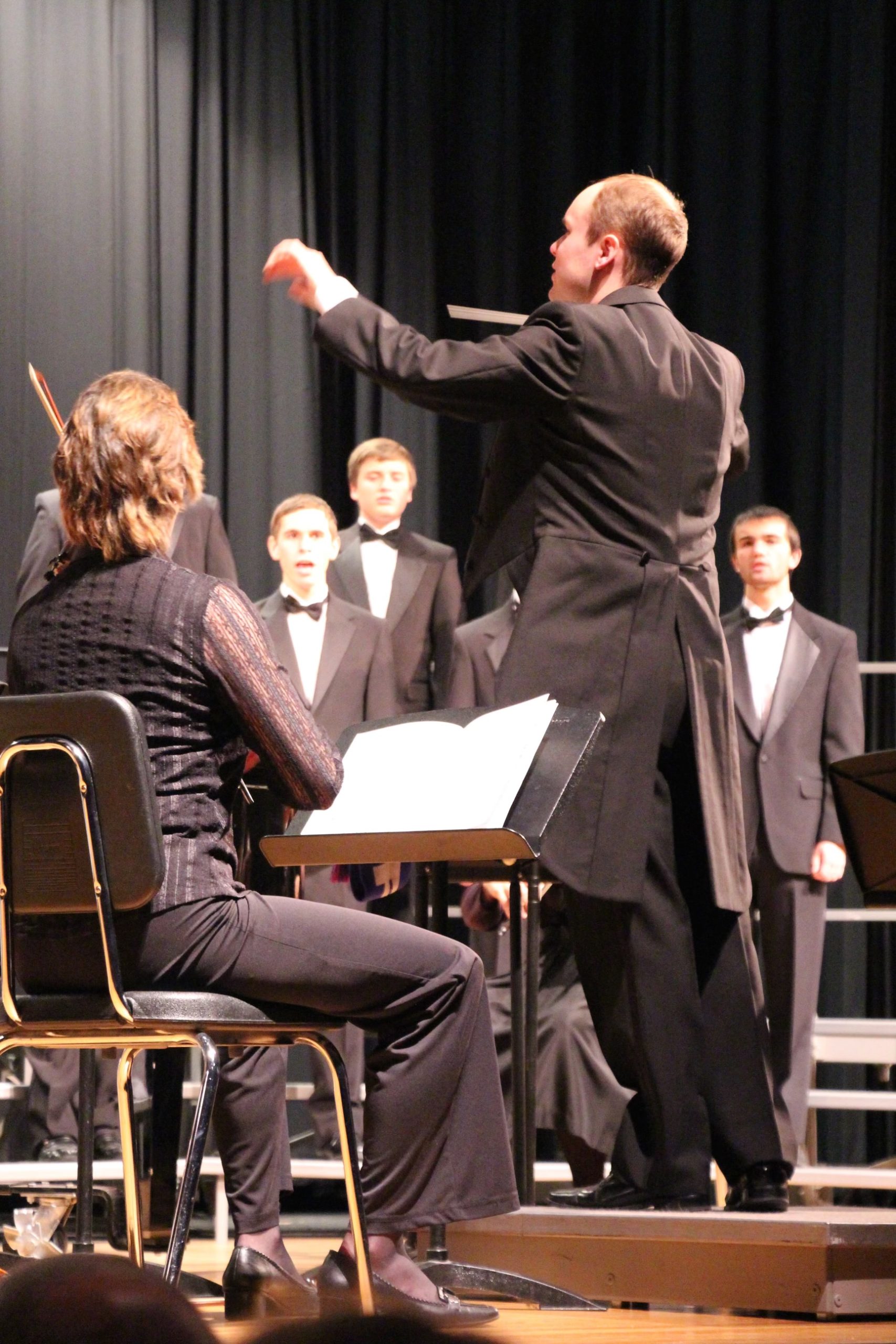
Conducting his advanced choir class at Grafton High School.

When I began teaching it was important to me to not only emphasize the technical aspects of music-making, but also the emotional, the ways in which making music together could transform perspectives and inform experiences. That transformation goes both ways – for the teacher, as well. I was fortunate to have a group of African American male students who transformed my views of the social role of education.

They’re the ones who really got me looking at the connection between education and society. They were the ones who opened my eyes about the systemic disadvantages that come with being a member of a marginalized community.

I’m forever grateful to them for being open and honest with me about their experiences because it really solidified the importance of education in society. So, it’s kind of been like a triangle for me, trying to incorporate the arts, education, society and how those pieces fit together and the power therein of when they do fit together.

You say that your “whole focus changed” after you left York County and went to Germany to further your studies and see more of the world. Why is that? (Drew received a master’s degree in conducting from the Hanns Eisler Hochschule für Musik in Berlin.)

In Germany, they emphasize music as something very sacred; it’s quasi-religious. So, the expectation is that we are there to serve the music as though it were a deity itself, and I fundamentally disagree with that. I think that music and the arts are there to serve us and they’re a means of connecting with real living human beings today, and so my time in Germany was a transitional period. I came back to the United States with this renewed purpose but also wanting to ask more questions and deeper questions.

Conducting for a German Radio national broadcast in 2018.

I can pinpoint the exact weekend when I decided to give up any dream of being a conductor or a fully devoted professional musician. I was invited to conduct in the south of Germany, in a town called Marktoberdorf – famous for its choir competition. I was staying in this old monastery that has been converted to a music center and there was this choir from Argentina that I was conducting. It was a great experience, but I brought with me a book by the philosopher Isaiah Berlin, and I was just so enraptured by his ideas on knowledge and society that I realized, as I was sitting in this modernized monastic cell, that my heart was in a different place.

I just wanted to sit and read and enjoy the sunshine coming into my window. It was springtime and I could smell the freshness of the earth outside and I was more focused on that and the ideas of the book than on actually conducting the ensemble.

I just knew that I was closing a door and I was doing that intentionally, shifting to something else.

Is that when you returned to Virginia?

Yes, I finished my master’s degree and the work that I was involved with in Germany before returning to Virginia. I became the vocal music teacher at Old Donation School in Virginia Beach and enrolled in a master’s degree program at UVA, studying Educational Psychology. The work I was doing in the classroom reflected the themes I was exploring in my studies.

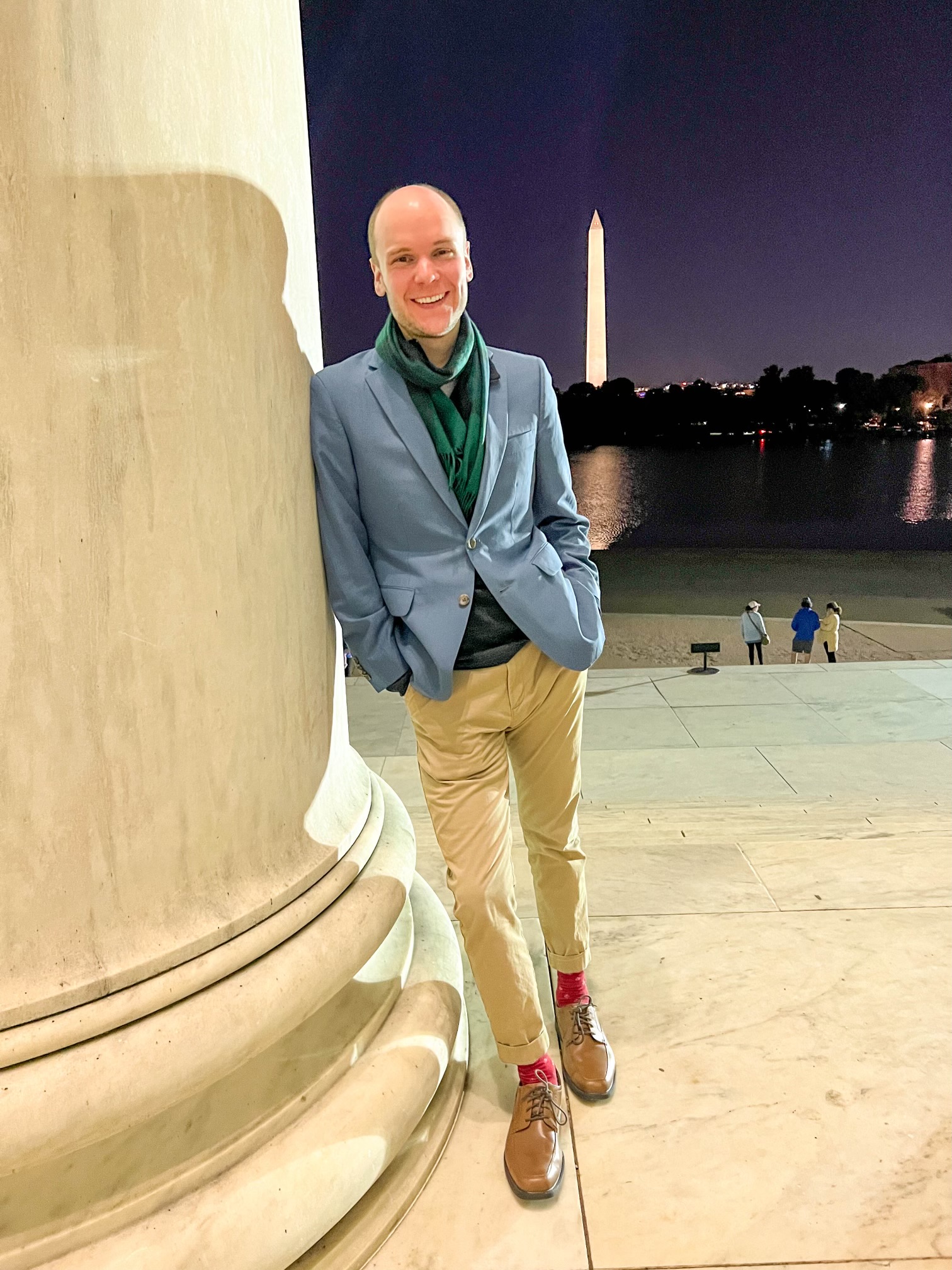
At the Jefferson Memorial.

At this time I also became a researcher for the university’s Institute of Democracy, tasked with compiling data on the national landscape of democracy centers at institutions of higher education. I began to reflect on the idea of democracy, particularly what democracy means for different people and how communities of different experiences and perspectives engage with democracy. This matched exactly what I did every day as a chorus teacher – it was my responsibility to facilitate dialogue and engagement among all of the students, ensuring that each student contributed their voice to our collective mission.

When conducting an ensemble, there are layers of interpretation – there’s the interpretation I create myself, the interpretation the collective ensemble creates, and the interpretation that individuals bring based on their own life. The beauty of the music experience comes from negotiating those interpretations so that our performance represents what we want to communicate both as individuals and as a collective. That is what democracy is, the negotiating between individual and collective identities to ensure authentic representation.

So what prompted you to leave teaching and join Arts for Learning?

I’ve begun to think more broadly about arts engagement. While I loved teaching and loved the students, I would like to utilize my ideas and my experiences to help foster collaboration between organizations and communities to ensure that everyone has an opportunity to contribute their voice and reflect on their perspectives and the perspectives of others through high-quality arts engagement.

As I’ve been investigating the social sphere and the social role of the arts, it’s clear that students are sometimes not presented opportunities in an equal way. And so, it’s up to organizations – like Arts for Learning – to fill those gaps for disadvantaged and marginalized communities where the arts are a powerful means of helping students achieve but also to feel represented and to represent themselves.

What are your goals with Arts for Learning?

In working with the existing artists on our roster, in recruiting new artists, and in developing programming, I want to make sure Arts for Learning is engaging students in ways that are appropriate for 21st century learners. The experiences we offer students should be 21st century experiences—so thinking about what is relevant to our students today, what is relevant about technology in terms of the way we consume the arts, and what are the relevant values we-as-a-society want to promote.

If you’re thinking about only using music and musical experiences to prepare kids to sit quietly at the symphony, that’s doing a disservice to the power of the arts today and the ways that the arts can connect, educate, and inspire today’s young students. Students are willing to be engaged and willing to create, but they want experiences that authentically engage and authentically reflect them.

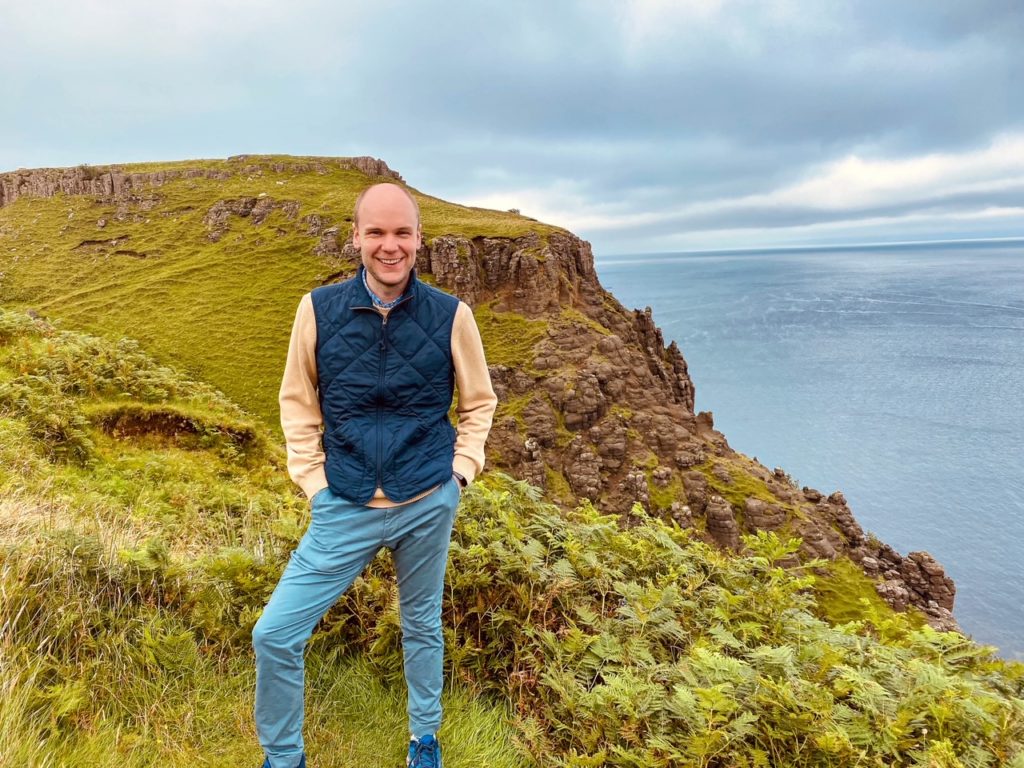
Visiting Scotland this summer.
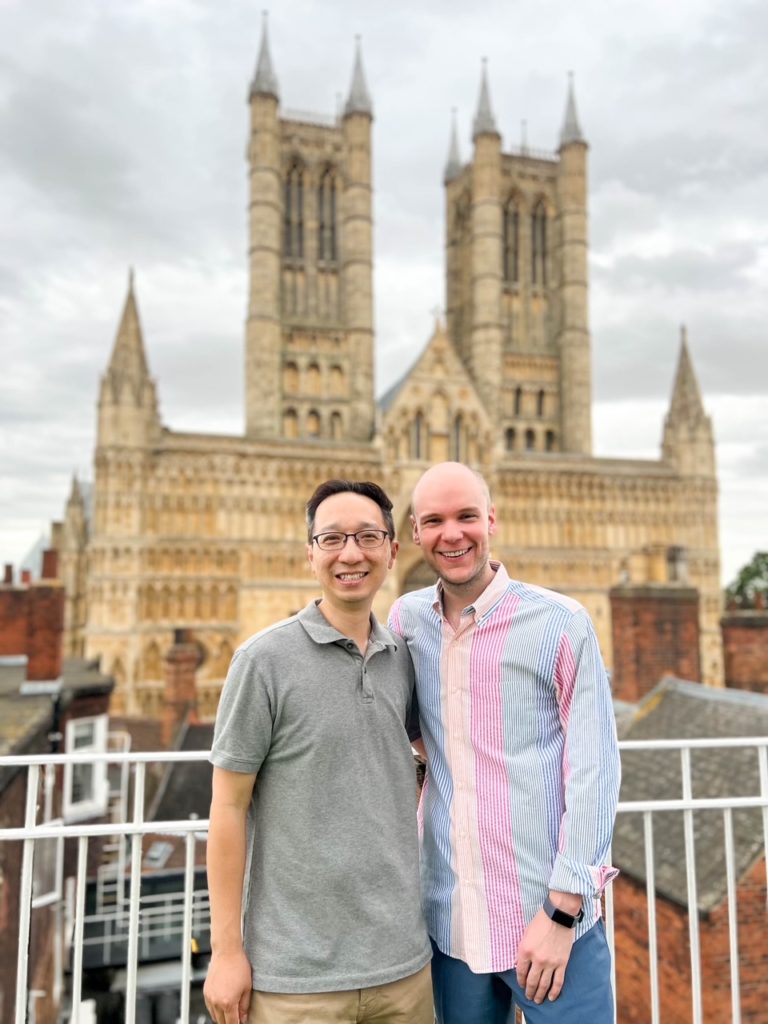
Drew and his partner, Kevin, in England this summer.
Singing at York Cathedral.

(An active member of the community, Drew sings in the Virginia Chorale and works as the staff bass at St. Paul’s Episcopal Church and at Ohef Sholom Temple. Drew lives with his partner, Kevin, in Norfolk.)

Discussing music with the conductor of the Virginia Chorale, Chuck Woodward.

I’ve got to ask – you grew up in Syracuse, went to college in New Jersey, and then lived in Germany – why settle in Virginia?

Well, in the fifth grade I had to do a presentation on Thomas Jefferson. Through my research for that project, I developed this idyllic, picturesque idea of Virginia, this view of rolling hills and Colonial Williamsburg and Monticello, and so I’ve just had this fascination since then. I feel a lot of pride when I tell people I live in Virginia. It feels like an accomplishment of mine, which seems kind of silly, but I love it. In three hours, I can be in D.C., in two hours I can be at Jefferson’s Monticello, in twenty minutes I can be at the beach, and every day I hear the fighter jets and see the aircraft carriers – what’s not love? I feel like I’ve come home.

A hobby of Drew’s is collecting and reading biographies of complex historical characters. Last year he started reading a biography of every U.S. president chronologically and is currently up to Jimmy Carter. Sourcing books is part of the fun–Drew had to look all over stores in Washington, D.C. just to find a biography of Rutherford B. Hayes!

Filed Under: Arts Integration, ArtsEd, News, Staff Spotlight Tagged With: Arts Ed, arts education, Drew Lusher, music education

Guiding Arts for Learning: Lessons, Challenges, and Achievements

September 14, 2022 By Cindy Sherwood

Chris Everly at the 65th anniversary celebration in September 2019.
CEO Chris Everly at the 65th anniversary of Young Audiences of Virginia, which was rebranded to Arts for Learning in September 2019.

Three years ago this month, Young Audiences of Virginia became known as Arts for Learning, a change announced to better reflect our mission as part of our nonprofit’s 65th anniversary celebration. We’re also celebrating another anniversary this year—Chris Everly became CEO five years ago in February.

Chris came to A4L after retiring from a 30-year career at Bank of America where she held several executive positions in the areas of credit and operational risk. In this “second act” at A4L, she uses her business acumen to lead an organization that combines two of her passions: helping children, especially those who are disabled or disadvantaged, and the arts. Chris received both her B.S. in Business Administration and her MBA from Temple University in her hometown of Philadelphia.

A resident of Virginia Beach, Chris and her husband John are the parents of two adult children. They adopted Katrina (nine months old) in May 1993 and Peter (two-and-a-half years old) in September 1993 from Russia. Katrina loves children and animals and has worked in jobs helping each. Peter works as a scenic artist for a repertory theater in Florida.

In this interview, Chris reflects on her time leading Arts for Learning, the premier arts-in-education organization in Virginia.

You’ve talked about your children having learning struggles when they were younger. How do you think the arts would have helped them?

“With hindsight we could have done more to actively engage them in the arts beyond taking them to art museums or concerts. For example, I didn’t focus on getting them piano lessons even though we have a piano because I was more worried about scheduling after-school reading enrichment lessons than playing the piano. We were so focused upon mastering the core academics. We knew all the statistics about kids not reading at grade level and what the future held for them. We were trying to do anything we could to give them a strong foundation for academic success. Greater involvement in the arts would have helped both of them with their self-esteem, confidence, and social interactions.

“It wasn’t easy for us or the children to cope with having learning differences, and so if I have the opportunity to encourage other parents who might be struggling to do the right thing for their child, I tell them I believe that giving them opportunities for active engagement with the arts is just as important as giving them a reading tutor.”

Peter eventually found his way to a career in the arts. How did that happen?

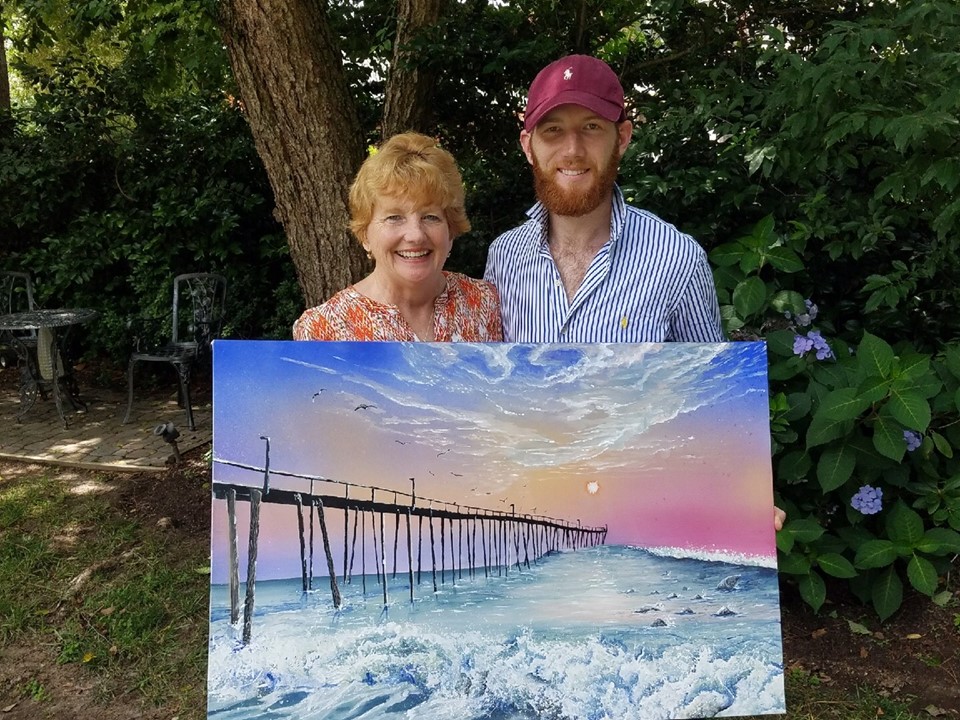
A painting Peter made for Chris that hangs in her office
Peter created this painting for Chris. It hangs in her Arts for Learning office in Norfolk.

“When Peter was in high school, he wasn’t sure what he wanted to do as a career or what to study in college. He’d heard about the Conservatory at Shenandoah University, so we arranged a tour. The admission director noticed his interest in scenic lighting and design and suggested he apply for that major. So even though I knew he had excellent visual art skills and a strong interest in design and building work, I’d never thought of it as something he could do as a career and be successful. The director, in fifteen minutes, figured out something that I should have considered before.

“I think the arts and being around other artists have helped his self-esteem and his confidence in his ability to master something new or difficult. Involvement with the arts has led to him being more open with other people and expressing curiosity. He was very shy when he was younger, but now he enjoys talking with anyone about anything. The arts filled a void in him that I didn’t understand how to help him address.”

If you were to tell someone why the arts matter, what would you say?

“I think the arts is a great equalizer. It’s a universal language with tremendous social-emotional benefits. At one time I would have minimized that. Now I fully understand, having had the opportunity to watch children participate in our programs and hear stories that our staff brings back about the power of the arts to make a difference.”

When you were first hired as CEO, what did you expect? Have there been surprises?

“I had been on three nonprofit boards in the past, so I’d had exposure to governance and interacting with paid staff, but I don’t think I fully appreciated all that would be asked of me as executive director, how much of a business it really is and how you have to think of it as a business. Our mission is to inspire and engage, but there are a lot of  different things that need to be in place behind that—technology systems, finance, all of the requirements for grants. Besides the ‘aha’ of what a difference the arts can make in the lives of children in ways I didn’t fully appreciate before—any child—I think I didn’t realize how much is involved behind the scenes in terms of administrative work that needs to be done to make the arts possible.

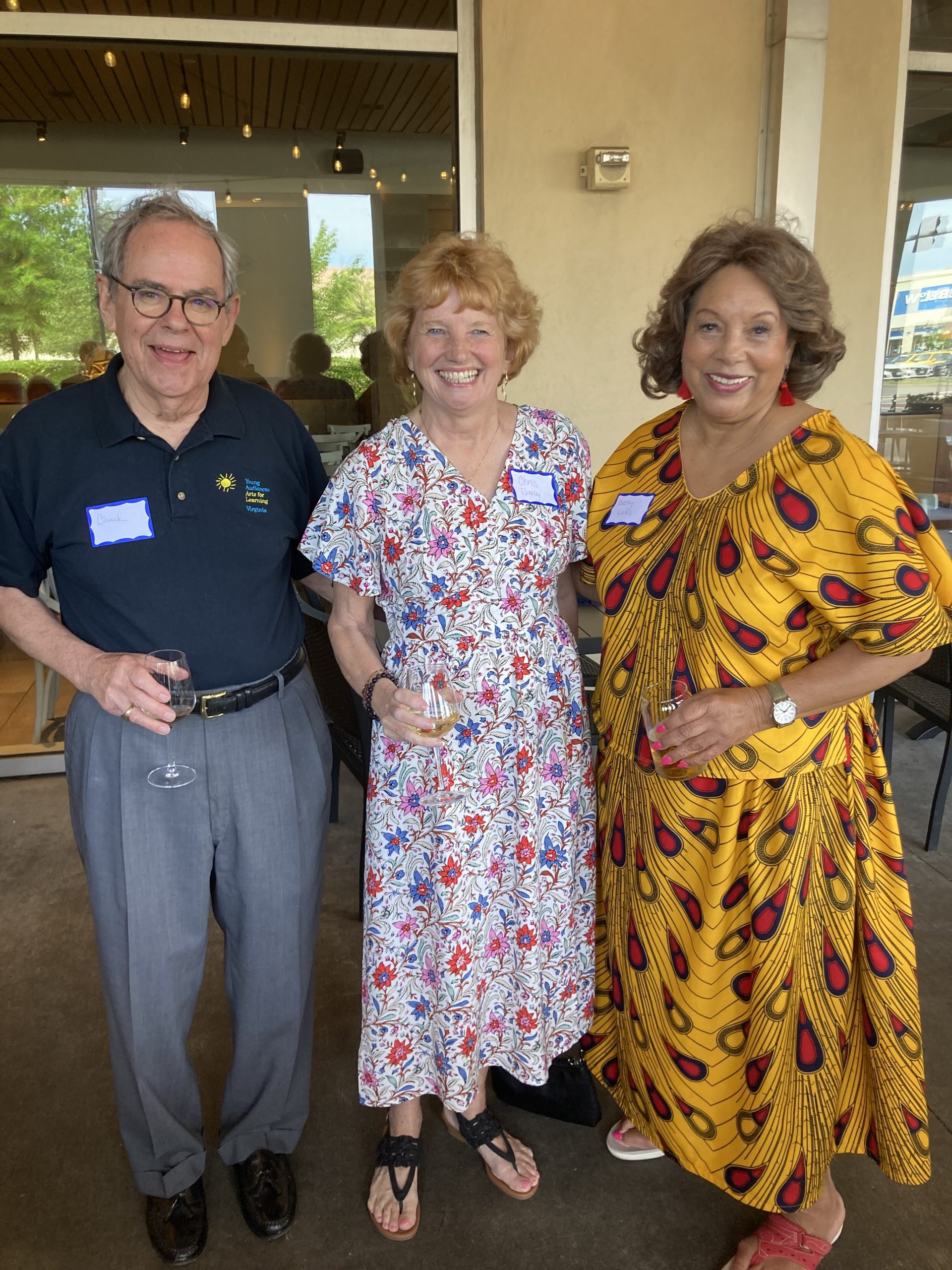
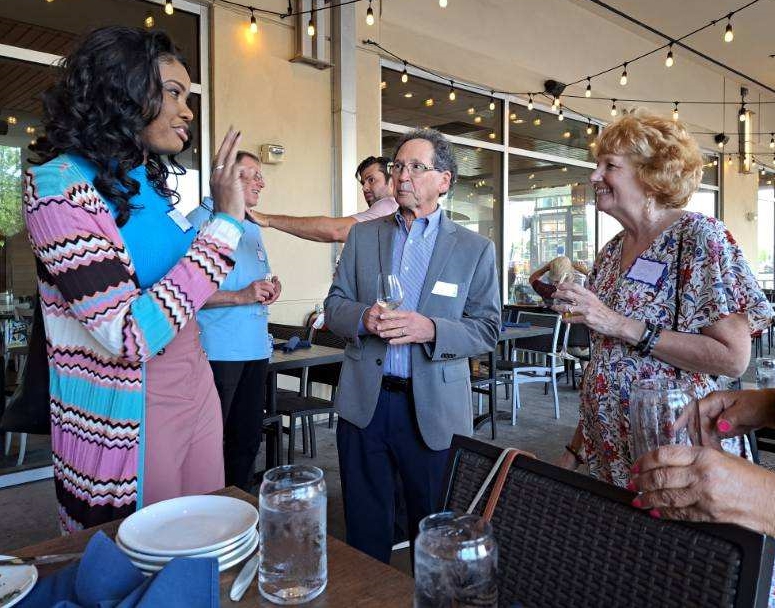
Immediate past president Chuck Spence, CEO Chris Everly, and board member Becky Livas at a gathering in Virginia Beach.

“One thing I learned from banking that I brought to this job is an understanding that relationships are everything—how you deal with all the different stakeholders and how they all need something different from you. You have to learn what’s important to them and respond appropriately.

“I’ve enjoyed great support and encouragement from the board of directors. A lot of executive directors struggle with their relationship with the board, who you’re working for. But that’s always one thing that has gone well, and I’m grateful for their dedication to our mission.”

What has been the biggest challenge during your first five years?

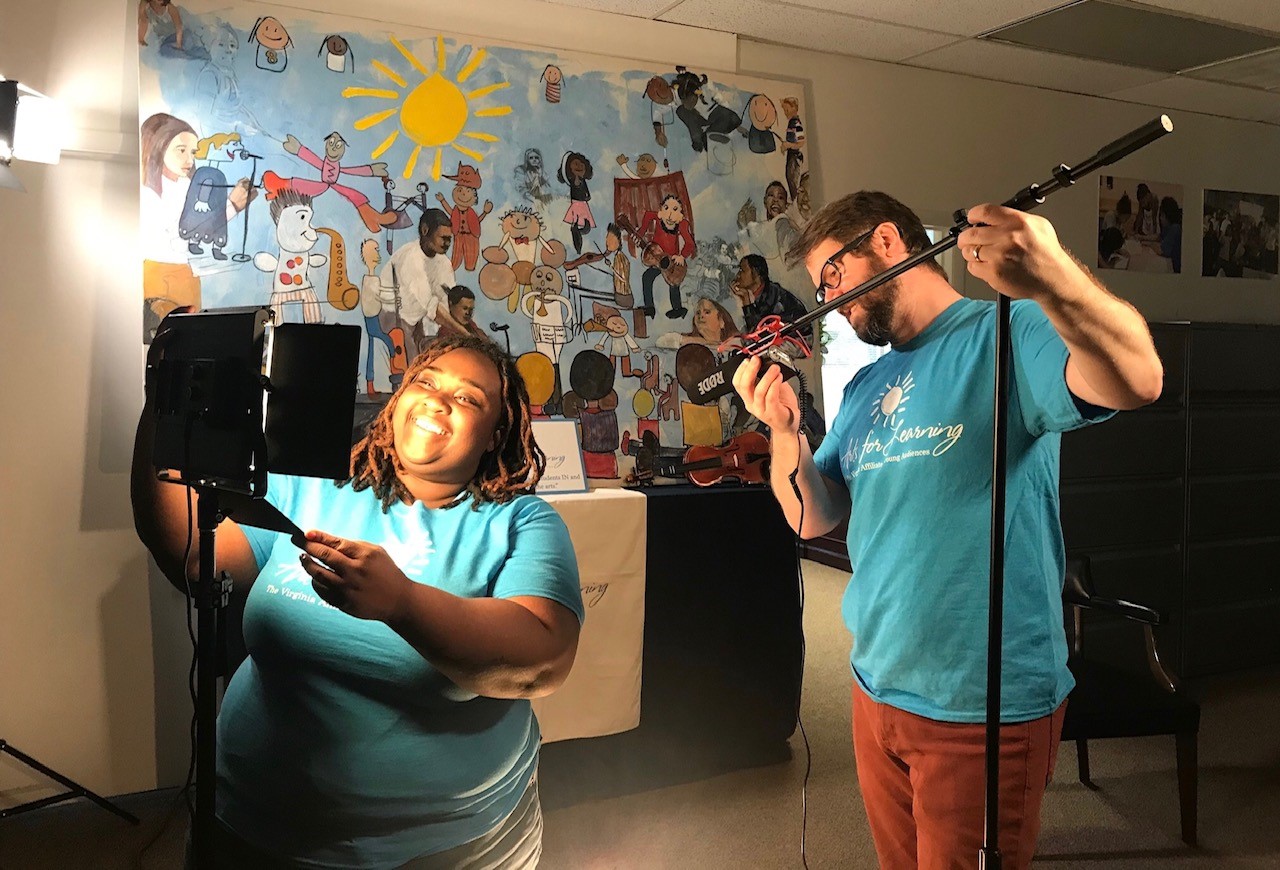
Aisha Noel and Aaron Kirkpatrick set up for recording "Take 10" in spring 2020.
Aisha Noel and Aaron Kirkpatrick set up for an artist to record a “Take 10” video segment in spring 2020.

“The pandemic upended everything for everybody. It was important to keep everybody on an even keel with the belief that somehow, someway, we would figure it out. Thanks to the creativity of the staff when schools were shut down, we produced ‘Take 10’ videos, short segments by our artists for families to watch at home with their children. It was the right thing to do—it gave artists the opportunity to practice their art form when normal opportunities weren’t available to them, so it fulfilled a need.

“At the bank, I was very involved in the commercial and residential real estate market, so I went through a lot of real estate cycles. And I realized eventually it does work out, so that gave me a little bit more confidence to say, ‘I don’t know how we’re going to do this, but if we work together as a team, we’re going to figure it out.’ That’s one advantage of being older. Having the perspective that things would work out meant there was no need to panic.”

What has been your biggest achievement?

“Our greatest achievement in the past five years is the way we’ve grown and adapted to the circumstances. We didn’t always know it would turn out well, but we deliberately took some risks, after careful consideration, that proved to be the right approach. Sometimes we had Plan A and then quickly had to switch to Plan B and it was finally Plan C or D we implemented.

“I’m really proud of the staff and how everyone who has worked here, even the ones who have left, have left the organization better in some way. We’ve had the right people in place at the right time.”

Where would you like to see Arts for Learning in five years?

Chris chats with board members Rae Benn and Michael Geller.

“I’d like to see us do more work outside of coastal Virginia. It would be good to figure out ways to expand our influence further outward in the state. We were getting ready to do more of that and then the pandemic hit. Now that we’re coming out of that and have built up our staff, it’s enabled us to seek out new opportunities and new relationships with other nonprofits. I think we’re focusing more on the greater community than we were able to do before and sharpening our focus upon how to best reach underserved children.

“We also want to continue to grow our board. It’s important that we have a diverse board, which I think we’ve done a pretty good job of building, but we need to look at how we continue to engage them and bring in new people as donors and volunteers.”

How have you grown as an individual in the five years you’ve served as CEO?

“I think it’s helped me be much more engaged in the larger community, raised my awareness and knowledge about social issues, and deepened my commitment to help change injustices and inequality. I’m a great believer in the importance of continuing to learn and challenging yourself through all the seasons of life. I love how this position exposes me to new ideas and a wide range of people with vastly different life experiences.

“I used to be quite reserved and shied away from asking people for money and from public speaking. But the organization is depending on me, so I’ve had to come through. I need to be the organization’s biggest cheerleader and spread the word about supporting our mission. I was actually a marketing major as an undergraduate, and that’s what I’d hoped to do. I get to do marketing all the time now, but in ways I never envisioned. Life’s come full circle.”

Filed Under: COVID-19, News, Staff Spotlight Tagged With: CEO Chris Everly

  • 1
  • 2
  • Next Page »
Phone: 757-466-7555
Follow Us on FacebookFollow Us on InstagramFollow Us on YouTubeFollow Us on LinkedIn

Join the Mailing List

Want to stay inspired? Join our mailing list and get the latest updates on Arts for Learning Virginia’s programs, performances, community partnerships, and arts‑in‑education opportunities. Connect with our mission, celebrate our artists, and never miss an event!

Select list(s) to subscribe to


By submitting this form, you are consenting to receive marketing emails from: Arts for Learning Virginia, 420 N. Center Dr., Ste 239, Norfolk, VA, 23502, http://www.Arts4LearningVA.org. You can revoke your consent to receive emails at any time by using the SafeUnsubscribe® link, found at the bottom of every email. Emails are serviced by Constant Contact

Main Office
Arts for Learning
420 North Center Drive
Suite 239
Norfolk, Virginia 23502

Phone: 757-466-7555

Main Office

Arts for Learning Virginia
420 North Center Drive
Suite 239
Norfolk, Virginia 23502
Phone:
757-466-7555

A Force for the Arts: Honoring Minette Cooper

In Hampton Roads, the arts are a living, breathing presence—heard in the rhythm of a drum circle, seen in a dancer’s arc across a school gym, felt in the hush that follows a poem. Few people did more to ensure those moments could happen than Minette Cooper. Her leadership, vision, and relentless belief in the […]

At Arts for Learning Virginia, we’re proud to be part of the Virginia Commission for the Arts’ Passport Program. While Passport holders typically receive free admission and 50% off classes at participating organizations, all our programming is always free—no discount needed. To learn more about our public events, check out our calendar of events page here.

Copyright © 2026 · Young Audiences | Arts For Learning | Virginia

Website Maintained By TechArk

×